Authored by: Ryan Hummel
Just as an audience experiences a symphony as one seamless performance rather than a collection of individual instruments, patients experience a health system as a unified whole rather than as separate hospitals, physician groups, service lines, and departments. They expect their care to be connected, coordinated, and consistent regardless of where they enter the system. A 2025 analysis of hospital mergers and acquisitions shows that 479 hospital mergers, acquisitions, and other consolidations or ownership changes occurred between 2016 and 2024 (Hospital Consolidation Continues, Contributing to Higher Prices and Spending)
Behind the scenes, however, many health systems operate very differently. Years of growth through mergers, acquisitions, and expanding care networks have created larger organizations, but not necessarily more connected ones. Clinical and administrative leaders often work within complex matrixed structures, with dotted-line reporting relationships and clinical and non-clinical dyad leadership models that distribute accountability across the organization. Add in Universities and Academics to the operating model, and the complexity intensifies. While these structures bring valuable expertise and collaboration, they can also create overlapping decision-making, inconsistent execution, and unnecessary variation.
Having partnered with more than five leading health systems over the past year, one theme has consistently emerged: systemness has become one of the defining priorities for healthcare leaders.
The organizations that will succeed over the next decade won’t simply be those that continue to grow. They’ll be the ones that unlock the disciplined pursuit of operating as closely to one as possible. Because when caregivers and colleagues act as one, patients experience one health system.
Beyond Organizational Redesign
Systemness is more than organizational redesign. It is the deliberate alignment of governance, leadership, operations, technology, and culture to function as a single enterprise – reducing variation, improving access, and creating a more seamless experience for patients and caregivers.
At its core, systemness is patient-centered. Surrounding that core is the unwavering belief that systemness will improve outcomes and facilitate innovation. It enables health systems to consistently deliver coordinated, high-quality care by aligning operating models and organizational structures around enterprise priorities rather than individual departments, hospitals, or legacy silos.
Patients may never see the governance decisions that happen behind the scenes, but they experience the outcomes every day – through more coordinated care, fewer handoffs, more consistent experiences, and easier access to the services they need.
The greatest opportunity for today’s health systems isn’t simply getting bigger. It’s becoming better at operating together.
Systemness Doesn’t Look the Same Everywhere
No two health systems are identical, and neither are their operating models. Systemness is not achieved through a single organizational structure or a one-size-fits-all governance model. Instead, successful organizations intentionally determine where different approaches create the greatest enterprise value. Some functions benefit from deeper integration. Others require structured standardization. In some cases, centralized authority creates the greatest impact. The key is making these choices deliberately rather than allowing them to evolve independently over time. Flexibility in the future seems like a contradiction; when it’s actually a necessity.
The Foundations of Systemness
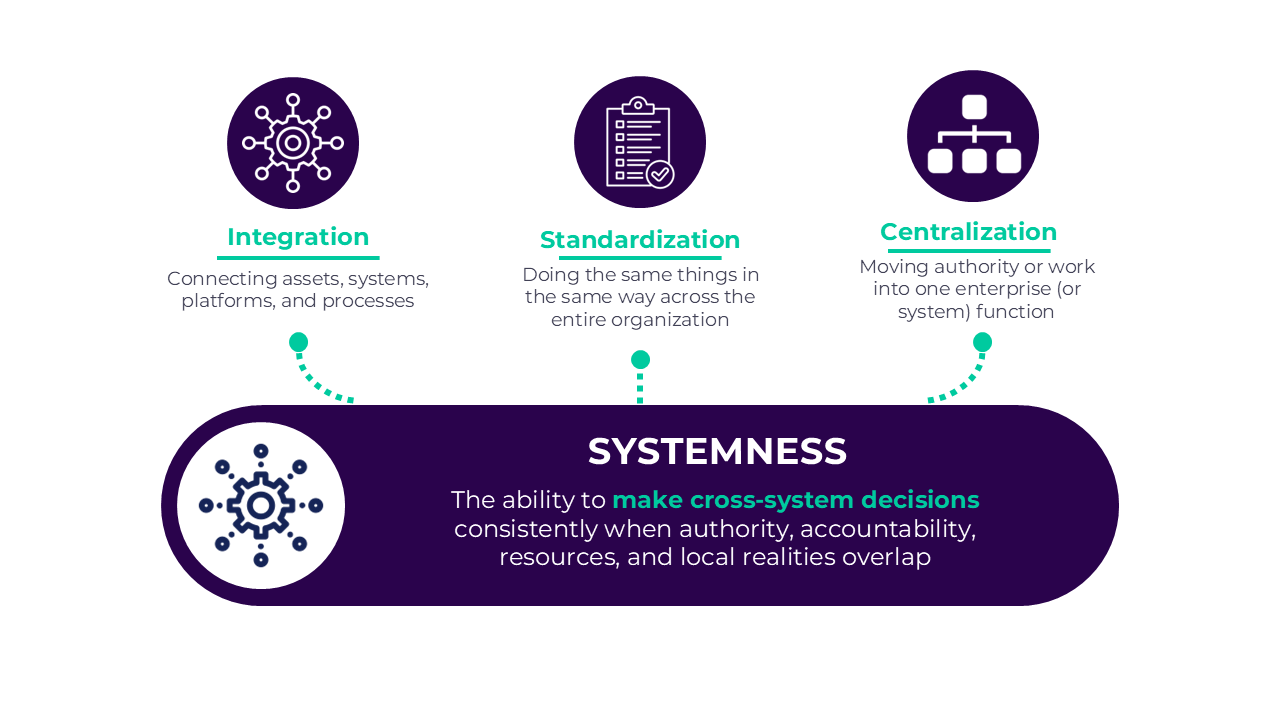
Integration: Connecting the enterprise
Integration creates the connective tissue across the organization. It links people, processes, technology, and decision-making around shared enterprise priorities rather than individual functional objectives.
Whether connecting service lines, care teams, digital platforms, or administrative functions, integration helps organizations eliminate silos that create friction for caregivers, colleagues, and patients alike.
When it comes to technology and platforms, we see health systems try to cater to the entrepreneurial spirit of highly talented clinicians and operators. Through this lens, new technologies are unlocked in silos, in groups, and without harmony across the system. Instead, creating strong governance and utilizing strong decision-making to land on the best decision for the system is not only preferred, but imperative for sustainability.
Standardization: Creating consistency where it matters
Not every process should be identical, but unnecessary variation comes at a cost.
Standardization establishes consistent ways of working across governance, operations, care delivery, and performance management while preserving the flexibility needed to meet local market or patient needs. By creating repeatable approaches where consistency delivers value, health systems reduce variation and improve reliability across the enterprise.
A familiar example health systems experience in non-standard work is in the access and scheduling worlds. Appointment scheduling, referral pathways, and triage are the first point of contact for patients; and countless systems create inconsistent experiences with different tools and platforms just because the larger team cannot make a decision on which solution to utilize. This is not effective.
Centralization: Clarifying decision-making
Some decisions create greater value when they are made once for the enterprise rather than multiple times across individual organizations.
Centralization establishes clear governance, decision rights, and accountability around strategic priorities. The goal is not additional bureaucracy or loss of local autonomy. It is ensuring that enterprise decisions are made with enterprise outcomes in mind. When leaders understand who makes which decisions – and why – the organization moves faster and with greater confidence.
One area where centralization seems like an inevitable value driver is care management. Because care management touches such a broad portion of the patient journey, Baylor Scott & White publicly touts its model: consolidated care coordination under a single, enterprise-level team, ensuring consistent processes, standards, and oversight across all sites. This is especially important as many health systems must manage the competing demands of value-based care and fee-for-service, sometimes within the same hospital room.
Across our work with leading health systems, we’ve found that organizations are most successful when they intentionally evaluate each function through the lens of integration, standardization, and centralization rather than applying a one-size-fits-all operating model.
Turning complexity into coordinated action
Most health systems in the US today operate within highly matrixed environments where authority, accountability, resources, and local realities overlap. Clinical and non-clinical dyad leadership models, shared governance structures, and dotted-line reporting all contribute to organizational complexity.
Without clear governance, these structures can create decision-making inertia. Multiple stakeholders may own pieces of a decision, yet no one owns the outcome. The result is slower execution, duplicated effort, inconsistent experiences, and resources spread across competing priorities.
In our experience, organizations make the greatest progress when governance becomes an enabler rather than another layer of oversight. Clear decision rights improve transparency, reduce duplication, and allow leaders to make cross-system decisions with greater confidence.
Reducing duplication allows organizations to redirect resources toward higher-value work. Clear governance reduces unnecessary variation, accelerates execution, and strengthens consistency across the enterprise. Financial performance improves as organizations spend less time navigating internal complexity and more time delivering value.
Just as importantly, colleagues spend less time navigating organizational structures and more time focused on caring for patients.
As health systems continue investing in AI, advanced analytics, and digital transformation, systemness becomes even more important. Technology alone cannot overcome fragmented governance or disconnected operating models. Instead, it amplifies the systems already in place. Organizations that have established clear decision-making and aligned ways of working are far better positioned to realize the value of these investments.
The Path Forward
Systemness is not an organizational initiative or a restructuring exercise. It is the disciplined pursuit of helping an increasingly complex health system operate as one enterprise.
When governance, leadership, operations, technology, and culture are aligned around shared priorities, health systems reduce variation, improve transparency, accelerate execution, and create a more seamless experience for both caregivers and patients.
Ultimately, patients judge a health system as one organization – not as a collection of hospitals, service lines, or departments. When caregivers and colleagues have clear decision-making, shared accountability, and act as one enterprise, patients engage with the health system as one as well.
If this perspective reflects the challenges your organization is navigating, we’d welcome the opportunity to share what we’ve learned from partnering with leading health systems to design operating models that enable them to function as one enterprise. To learn more, click here and complete the form to connect with our team.