Authored by: Nadine Taylor, Gemma Pfister, and Amanpreet Singh Loomba
Our Vynamic team came away from this year’s Pharma Launch Excellence (PHLEX) Summit truly inspired and reassured. Inspired by the energy, curiosity, and ambition of launch leaders across the industry and reassured that the challenges we see every day with our clients are the same ones keeping even the most mature organizations up at night.
Leaders across Launch Excellence, Medical Affairs, Commercial, Supply Chain and beyond, shared their perspectives on challenges and “what good looks like” whilst explored what it will take to achieve true launch excellence in the years ahead. Across presentations and coffee conversations, there were common themes that stood out including that the industry is actively redefining how it balances AI, data, technology, and human insight to build a next-generation approach to launch planning and execution.
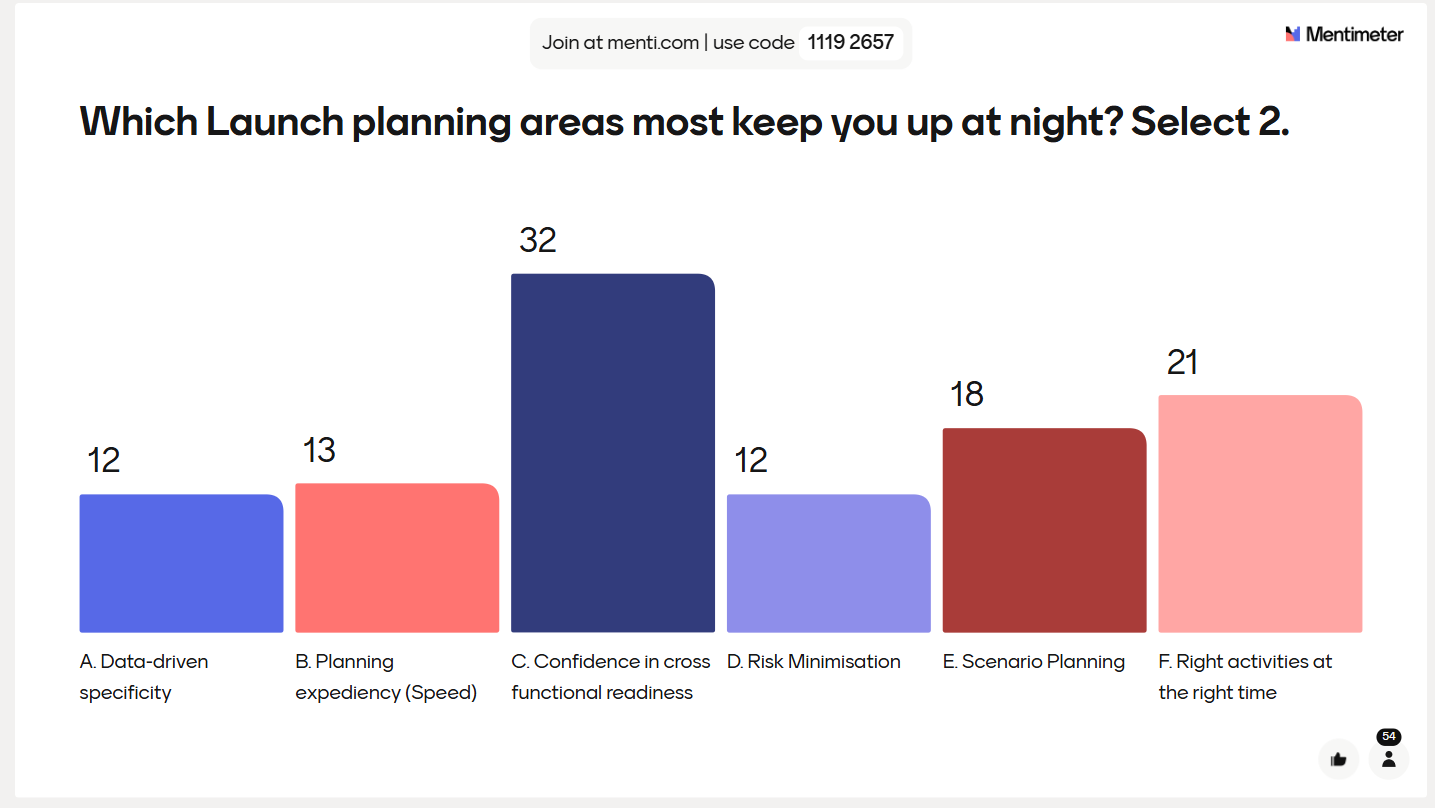
When we surveyed delegates, 54 respondents indicated the biggest launch planning area keeping them up at night is “confidence in cross-functional readiness” (30%). See Figure 1. The data showed the following areas are also top of mind and a priority to solve for; data-driven specificity, planning expediency (speed), risk minimisation, scenario planning and executing the right activities at the right time.
Here, we are sharing the most resonant themes we took away from this year’s summit.
Theme 1: Early Cross-Functional & Geographic Alignment Are Now Mission-Critical
This year at PHLEX, there was strong representation from both global and regional leaders, including representatives from growing, emerging markets and local countries.
A standout theme at PHLEX was the growing recognition that launch success is no longer determined by the launch plan itself – but by the alignment and collaboration behind it.
Delegates emphasized:
- Global teams feel pressure to drive standardization
- Countries want empowerment and speed
- Functions operate at different rhythms and evidence thresholds
- External environments are shifting faster than historical launch models can adapt.
The result? Many teams are planning in parallel rather than planning together.
The future of launch demands:
- Robust change management execution and cultural appreciation
- Earlier cross-functional collaboration, before decisions harden
- Earlier, collaborative global-local co-creation, not late in the day with forced downstream alignment meetings
- Flexible tools, frameworks and ways of working that allow teams to pivot as new data emerges and unpredictable events unfold.
Theme 2: Then is “too early”? The industry is rethinking the starting line for launch planning
We often know that starting planning too late creates downstream challenges… but when is the best time to start?
Conversely, some organizations struggle with the opposite problem – starting the planning early, but without the right clarity, inputs, or alignment.
The summit conversations surfaced that:
- Planning too late especially in apparent volatile clinical, competitive, or regulatory environments creates irreversible downstream pressure on countries, functions, and supply chain. Equally, the planning conducted must be agile to keep up with the ever-changing launch environment.
- There was appreciation amongst the community on the importance of early “thinking” and “internal alignments” to be strategic, flexible, and insight-driven – not simply the re-use or creation of templates or Gantt charts.
- Initiating cross-functional insights gathering and strategic thinking with agile and dynamic planning capabilities enables essential collaboration and strategic alignment – starting too late too late creates irreversible downstream pressure on countries, functions, and supply chain.
Our view is to set a solid foundation; early launch planning should typically commence 4-5 years prior to launch and focus on deep understanding of the market landscape, enabling hypothesis-building and stakeholder mapping, scenario exploration, and early collaboration with cross-functional teams and Global/Local markets.
Theme 3: The industry is hungry for evolved & better benchmarking, measurement & evidence
If there was one refrain that echoed across the sessions, it was this: current launch benchmarking simply isn’t enough anymore. Delegates repeatedly pointed out that the metrics we’ve all relied on for years including market share curves, IQVIA data comparisons and historical analogues – no longer capture the full reality of what determines launch success. Teams want to know not just how they’re performing, but why, compared to whom, and based on what evidence.
Many attendees described feeling stuck with KPIs and forecasts that are retrospective, narrow, or overly commercial, while the real drivers of launch performance increasingly sit upstream in readiness, experience, and organizational alignment.
Below are a few unmet needs discussed in the “cross-functional forum”:
- A need for real-world measures of functional readiness
The industry needs ways to measure whether cross-functional teams are actually equipped to execute and not just whether there are existing plans on paper – it’s not enough. They highlighted gaps in assessing decision-making maturity, escalation clarity, field preparedness, and organizational confidence.
- A deeper understanding of how launch planning shapes outcomes
Participants voiced a desire for more evidence around how early choices – resourcing, messaging, stakeholder mapping, evidence planning – ultimately affect sales trajectories, patient impact, and even internal engagement. Many noted: “It’s hard to improve what we can’t see or quantify – you don’t know what you don’t know.”
- Appetite for stronger scenario planning and simulation capabilities
Teams want more robust pressure-testing, not just theoretical exercises. Delegates discussed the value of “rehearsing the launch” the same way companies rehearse crisis response or supply chain disruptions – with realistic scenarios, cross-functional decision-making, and clear success criteria.
- Bringing population health insights into launch planning earlier
A recurring theme was the need to pull in broader population-level and system-level evidence much earlier – moving beyond traditional epidemiology to understand access dynamics, care pathways, health equity considerations, and system burden. Several noted this as a big untapped opportunity.
What these discussions may signal
This theme reflects an industry that is shifting from launch as a brand launch moment to launch as an enterprise capability. And enterprises want better instruments, better diagnostics, and a clearer read on what “good” actually looks like.
Theme 4: AI Is accelerating the launch playbook – but establishing a working end-to-end solution, remains a challenge
If there was a single topic that underpinned discussions throughout the summit, it was this: everyone is curious to or already experimenting with Data and AI, but very few have cracked how to apply it meaningfully to launch planning and execution.
Global teams, in particular, voiced excitement about using AI to save time and leverage prior learnings to help countries and individual functions draft tactical launch plans “in 2-3 minutes” freeing teams to focus on strategy and collaboration rather than documentation. However, most organizations admitted they remained firmly in pilot mode.
Looking ahead: Launch excellence is being rewritten – together, we can shape what comes next
Pharma is entering a new era where experience, lessons learned and supporting AI accelerates the “doing,” but cross-functional thinking, early alignment, and strategic adaptability are critical for success.
The summit made it clear: The summit made it clear: pharma companies don’t just need better plans – they need to lean on, and further evolve, a community of real-world launch experience and real-world data, AI, and supporting technologies. This will help bring together expertise to equip the industry in succeeding in this new era of higher-pace and agile product launch environments.
Final thoughts
Whether you’re preparing for a first-time launch or scaling for future growth, one truth remains: success depends on how well your teams think together, plan together, and adapt together.
The PHLEX Summit reinforced that we are entering a moment where launch excellence is no longer defined by a static plan but by dynamic readiness, cross-functional alignment, real-world insights, and the smart use of AI to accelerate – not replace – human judgment.
As an industry, we now have the opportunity to rewrite how we prepare for launch. And at Vynamic, we are excited to partner with teams to bring together strategy, collaboration, and intelligent commercialisation to help every asset not just launch, but thrive.
It’s not just about faster planning – it’s about bringing others along on the journey, building flexible structures, and fostering the ability to pivot as conditions change.
At Vynamic, we help life sciences organizations bring clarity to complexity, combining strategy, experience design, and change leadership to turn ambition into action.
Contact Us.